

Hempstead's public housing authority discriminated against people of color and with disabilities, feds say
Tamara Bennett-Bryant took the advice of friends in the deaf community and headed 2 miles from her mother’s home in Hempstead Village to the Town of Hempstead Housing Authority to apply for public housing for her family, including her daughter and newborn son.
The authority replied in a letter: "There may be a lengthy wait before your application is reached on the waitlist."
Nearly a decade later, the 48-year-old, who is Black, is still waiting her turn. Pervasive local government discrimination may be a reason why, federal housing investigators say.

Tamara Bennett-Bryant said the Town of Hempstead Housing Authority isn't treating her equitably despite her disability. Credit: Newsday/Drew Singh
The Town of Hempstead Housing Authority used an unlawful point system to curate its waitlist, "systematically" denied housing to disabled people and facilitated "acute racial segregation," according to a probe carried out by the U.S. Department of Housing and Urban Development.
WHAT NEWSDAY FOUND
The U.S. Department of Housing and Urban Development found the Town of Hempstead Housing Authority uses an unlawful point system that discriminates against applicants who are persons with disabilities and people of color.
The housing authority curated a system that in effect favored elderly white residents, according to the HUD investigation.
Ed Cumming, housing authority executive director, denied wrongdoing, claiming its housing is intended for seniors, while elected federal officials demanded immediate action to ensure equitable access to housing.
The end result: a system that for over a decade has consistently benefited elderly white people, HUD found.
The HUD investigation concluded the taxpayer-funded authority methodically blocked disabled persons and people of color from subsidized housing in one of the most segregated suburban counties in the United States, making it harder for low-income residents to find housing in a market where average monthly rents top $3,000 and the median home in Nassau County costs $875,000.
Newsday obtained a copy of the investigation’s findings through a series of public records requests. HUD found the authority violated civil rights, accessibility and fair housing laws.
The town housing authority, Long Island’s largest, with 1,300 units across 14 complexes, hasn’t publicized the letter, which it received in December 2024 — the end of President Joe Biden’s term. The Trump administration recognized the findings in a memo, acknowledging: "There are several remaining significant civil rights and programmatic compliance concerns."
The housing authority’s rules, HUD said, keep Black and Hispanic families from having the same access as their white counterparts to public housing.
"The process has been very unfair," Bennett-Bryant said recently through an American Sign Language interpreter. "I feel that I’m not being treated equitably."
Credit: Newsday/Alejandra Villa Loarca
The authority has been transparent and open in providing living accommodations for the local senior population.
— Ed Cumming, Town of Hempstead Housing Authority executive director
The housing authority says it has done nothing wrong.
Its leadership insists its housing is for town senior citizens — which is in direct conflict with HUD’s allegations that the housing is to be equally available for senior citizens or disabled people of any age.
"The authority has been transparent and open in providing living accommodations for the local senior population," the authority's executive director, Ed Cumming, said in a statement when asked about HUD's findings.
Most of the authority’s properties were "designed specifically as accommodations for the elderly," according to certain 1960s and 1970s documentation the authority provided to HUD. Disabled young people were eligible for "elderly" housing at that time, according to a research paper published in 2024 by HUD.
Cumming didn’t respond to a request for an interview, but added in his statement that the authority "has scrupulously adhered to fair housing provisions and all other applicable laws and regulations."
"The housing authority will vigorously defend any false accusations against it," he continued.
When asked by Newsday whether the housing authority filed an appeal of HUD’s findings, Cumming said that it "does not comment on intra-agency matters under review other than to say that the authority complies with rules and regulations under which it operates."
The members of Long Island's federal delegation representing Hempstead called HUD's findings "serious," "concerning" and "unacceptable."
Rep. Laura Gillen (D-Rockville Centre), who was Hempstead Town supervisor in 2018 and 2019, said in a statement that the town "must immediately address these concerns and ensure all residents have access to affordable housing units."
Sen. Kirsten Gillibrand (D-N.Y.) said the discrimination described is "deeply concerning and completely unacceptable" and that she's requested an update from HUD.
"I expect a thorough plan for how to address this situation," Gillibrand said in a statement.
James Martin, a spokesperson for Senate Minority Leader Chuck Schumer (D-N.Y.), said in a statement that HUD's letter contained "several serious and concerning discrimination charges" and the agency "should be transparent with the public."
A spokesperson for Nassau County Executive Bruce Blakeman, a Republican running for governor, didn't answer a request for comment.
The point system
HUD’s investigation found that the Town of Hempstead Housing Authority "effectively operates" most of its apartments as "elderly-only, despite HUD’s explicit denial of approval to do so."
The denial came in 2009, when the housing authority unsuccessfully requested to designate most of its units for senior citizens. The authority reapplied last year, acknowledging the previous rejection.
HUD could refer the case to the U.S. Department of Justice or withhold certain taxpayer funds, but since President Donald Trump retook office in January 2025, it has done neither, according to available public records.
The town housing authority receives about $8 million annually from the federal government for operating and capital costs, according to HUD data.
HUD officials didn’t answer a request for comment.
The crux of HUD’s allegations centers on the point system used to determine who gets off a waitlist that, as of December, had 1,308 families on it, according to the housing authority. The wait is the longest for any housing authority in the nation, with at least 1,000 apartments, according to a Newsday analysis of HUD data.
The system provides 3 points to applicants 62 years and older, but none to those who are disabled and of working age — despite HUD saying the groups should have equal opportunity for housing.
Those in the unincorporated part of Hempstead Town receive 2 points, and those in one of the minority-heavy villages receive 1 point. Zero residency points are awarded for those who work in the town but do not live there.
"This is one of, if not, the most damning letter of findings I’ve ever seen from HUD to a local government or housing authority," said Thomas Silverstein, executive director of the fair housing advocacy nonprofit Poverty & Race Research Action Council.
Silverstein, a leading expert on federal fair housing law, reviewed the documents obtained by Newsday. He was a part of a legal team that sued Nassau County and Garden City over fair housing claims last decade.

Credit: Mark Abraham
This is one of, if not the most, damning letter of findings I’ve ever seen from HUD to a local government or housing authority.
— Thomas Silverstein, fair housing expert
Ian Wilder, the executive director of Long Island Housing Services, a fair housing nonprofit, said typically there are one or two problems raised by HUD investigative reports, if they even reach that level of severity.
In this case, he said, the 18-page letter is a "literal catalog of issues."
"I am absolutely stunned," Wilder said. "I could never imagine this many problems."
HUD officials addressed their letter to Doug Gansler, one of the housing authority lawyers and a former Maryland attorney general. He did not respond to a request for an interview.
Town of Hempstead leaders appoint members to the housing authority board. Brian Devine, a spokesperson for Town Supervisor John Ferretti, did not respond to a request for comment.
‘Pervasively disadvantaged’
Since Bennett-Bryant was living in the Village of Hempstead, with a population that is 94% people of color, she received half the number of waitlist points of someone who lives in the unincorporated part of the town, reducing her chances for a subsidized unit.
While the villages — Hempstead, Rockville Centre, Freeport — have their own housing authorities, anyone within the town must have an equal opportunity for housing, HUD said. This is to avoid policies that could lead to segregation.
The point system has likely led to a whiter population in the housing authority’s units than would have been likely had it followed the law, according to HUD.
When HUD began its investigation in 2022, more than half the housing authority’s population was white, although Hempstead Town is now majority people of color, according to federal data.
The town housing authority has about 100 apartments at its two general population complexes, Inwood Gardens and Bayview Gardens. Those residents are almost exclusively Black.
The authority has 12 complexes intended for the elderly and disabled persons. Half contain mostly people of color. The other half have a majority of white residents. This effectively segregates town housing authority residents in violation of civil rights laws, HUD said.
A white applicant’s typical waitlist score was five 5 points to a Black person’s 3 points, according to HUD.
"Black and Hispanic households have been pervasively disadvantaged," HUD said, "through unlawful preferences and practices."
The housing authority also maintained a system to allow applicants to effectively pick the development they want to live in while not jeopardizing their place on the waitlist.
The result is that the population of some complexes are almost completely white while others are nearly entirely Black.
This "facilitated acute racial segregation," HUD said.
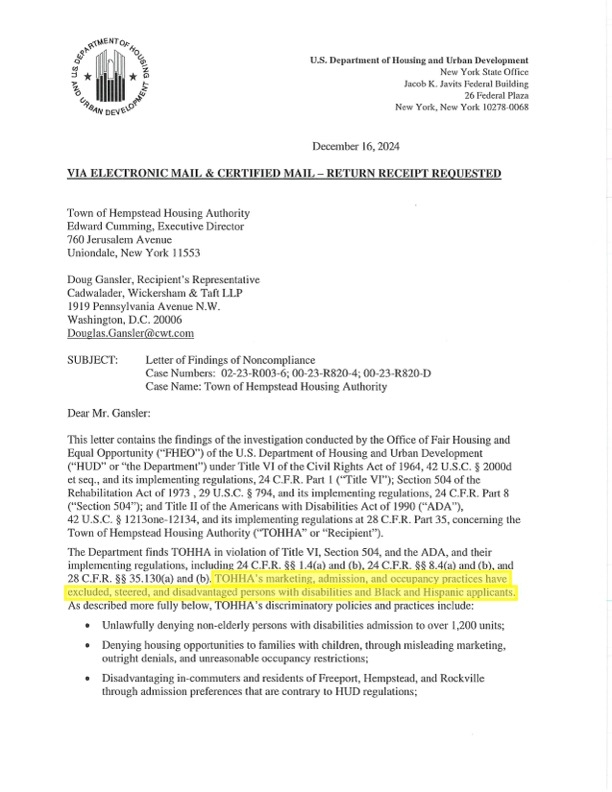
"TOHHA's marketing, admission, and occupancy practices have excluded, steered, and disadvantaged persons with disabilities and Black and Hispanic applicants," HUD wrote.
And the housing authority limited the number of people who could reside in a studio, one-bedroom or two-bedroom apartment to fewer than specified in the town’s building code.
Black and Hispanic households generally are larger than the number of people in a white household, HUD said.
"These policies disproportionately harm Black and Hispanic households," HUD said.
The result meant fewer families with children, like Bennett-Bryant’s, could live in one of the studio or one-bedroom apartments that make up nearly all of the authority’s units in its senior and disabled properties.
Because of its "exclusion of families with children," HUD found, eligible Black and Hispanic applications are denied housing at rates higher than they should be.
It’s "blatant discrimination," said Elaine Gross, founder of ERASE Racism of Nassau County.
"The findings from HUD are stunning," Gross said. "They do really suggest, strongly, that this is blatant, the actions are blatant, it’s not a mistake that somebody made once."
The housing authority’s practices "excluded, steered and disadvantaged persons with disabilities and Black and Hispanic applicants," HUD said.
Hempstead civil rights attorney Frederick K. Brewington expressed concern over HUD’s allegations of "steering" Black and white residents to separate public housing complexes.
"If you really wanted to build community, you would not be fostering segregation," Brewington said.

Credit: Rick Kopstein
If you really wanted to build community, you would not be fostering segregation.
— Frederick Brewington, civil rights attorney
Based on HUD’s findings, the housing authority operated a "waitlist to Neverland" and the Town of Hempstead had "egg on their face," Brewington said.
Bennett-Bryant said she didn’t want to talk in detail about her race possibly being a factor in her wait for a response from the housing authority.
"It should just go by your qualifications — not the particular area you’re living in," she said in an interview in a courtyard at her mother’s home.
Average waitlist score
About 9,000 seniors and nearly 4,000 working-age adults under the poverty line in Hempstead Town have a disability, according to census data.
Despite disabled, working-age adults making up about 30% of the town's eligible population for public housing, they account for just 5% of the residents in the housing authority’s units for the elderly or disabled people.
Elderly applicants had an average waitlist score of 4.5 compared with the nonelderly’s 1.6 average score, according to HUD.
The housing authority, HUD said, has "denied admission to qualified households with disabilities for over a decade."
Elderly people make up two-thirds of the waitlist and have been selected 94% of the time since 2017. Nonelderly disabled people make up 16% of the waitlist but have been selected 4% of the time, HUD said.
No housing authority in the nation with at least 1,000 units in its portfolio has a higher share of its residents as seniors than the Hempstead housing authority, a Newsday analysis of HUD public data shows.
The waitlist is currently closed, according to the housing authority and town websites.
It takes an average of eight years to get off the housing authority’s waitlist — more than double what it was a decade ago, according to HUD data.
Renters in the private market pay more than three times the rent for an average apartment in the Town of Hempstead than those who rent from the housing authority, a Newsday analysis of HUD data shows.
In public housing, rents are capped at 30% of household income; Town of Hempstead Housing Authority tenants pay $584 on average.
Little information is made widely available to applicants when they apply and while they wait.
The housing authority "does not furnish basic information about its housing programs," HUD said. It does not provide information on the waitlist, including its length. And, HUD said, it provides "scant information" to applicants, which is "unusual."
Bennett-Bryant was at a significant disadvantage — she's deaf, a Hempstead Village resident and has young children — as she attempted to obtain subsidized housing through the town’s housing authority, based upon HUD’s findings.
She would have likely scored 1 point in the waitlist, according to the point system.
She’s been waiting nearly 10 years for a call from the housing authority.
"I was hoping I’d be able to explain my story to somebody," Bennett-Bryant said.
The world has to know about her wait in order to fix issues HUD found at the housing authority, she said.
"This is supposed to be fair housing," Bennett-Bryant said.
If you applied to live in public housing on Long Island, we would like to hear from you. Send your story to publichousing@newsday.com.
