

These young Long Island immigrants are legally shielded from deportation. ICE is arresting them anyway.
Illustration by Neville Harvey
The 20-year-old neuroscience major thought she was doing everything right.
She dutifully attended virtual court hearings during the pandemic to get a judge to find she'd been abandoned by her father in Honduras. In high school she became a certified nurse assistant. She consistently checked in with her immigration lawyer.
The young woman from Uniondale came to the United States at 13 and reunited with her mom after bullying in her home country, where she was raised by her maternal grandmother. She secured a humanitarian protection for vulnerable young immigrants and enrolled in college upstate — something she previously thought impossible — with a scholarship.
Now she's afraid to leave campus to go to Target or stroll the aisles at Walmart.
WHAT NEWSDAY FOUND
- ICE this year has detained at least a dozen young people locally with a special immigration status that protected them from deportation. The men, all of whom are from Central American countries, were released after challenging their detentions in court.
- The agency last year deported 132 people nationally with this status.
- Special Immigrant Juvenile Status applications have exploded in recent years. Roughly 78,000 people under the age of 21 applied nationally during the last fiscal year, up from 11,500 in 2015.
The college sophomore, who did not want to be named for fear of deportation, is among thousands of young immigrants nationwide with Special Immigrant Juvenile Status, a federal protection for young people who were abused, abandoned or neglected by at least one parent. Previously, the status shielded recipients from deportation while they waited to apply for legal permanent status, also known as a green card.

The 20-year-old Uniondale woman, who asked not to be named for fear of deportation, has Special Immigrant Juvenile Status. Credit: Safe Passage Project
Not anymore.
Across Long Island, young immigrants who came to this country years ago as children or teens — and believed the status would protect them — are learning that security is eroding. The Trump administration last month announced changes to the program that no longer shields new applicants from deportation.
So far this year, U.S. Immigration and Customs Enforcement agents detained at least a dozen people locally with Special Immigrant Juvenile Status, according to a review of hundreds of legal petitions filed in the Eastern District of New York.
Newsday's analysis offers the first comprehensive look at how President Donald Trump’s immigration dragnet is capturing not just people attempting to follow the formal path to legal status, but the people doing so with what they thought was an explicit deportation protection, known as deferred action.
ICE agents arrested some of the 12 while they did mundane daily tasks: driving to work, walking to lunch, heading to a train, or simply being in the wrong place while agents looked for someone else.
Watch: 'A jumping off point to a green card'

The arrests are also drawing scrutiny from a Trump-appointed federal judge who questioned ICE's tactics as unconstitutional.
After Trump ratcheted up his crackdown last spring, the neuroscience major said she stopped celebrating her friends' birthdays at off-campus restaurants. Now, when she gets on the Amtrak home to Uniondale, she prays, telling herself she's going to be OK.
"I was like, ‘What if they take me and I don’t see my family again. Where am I gonna go?" she said in an interview in late April from her dorm room.
What if they take me and I don’t see my family again. Where am I gonna go?
— 20-year-old Uniondale woman with Special Immigrant Juvenile Status
The woman became eligible in March to apply for legal permanent residency. She has not been detained — but is still scared that might be her fate.
"When something like this happens to you, it just — it sticks. It sticks with you. It's like getting burned and nothing feels safe anymore," said Rachel Jordan, a managing attorney at Safe Passage Project, a nonprofit immigration legal organization that's representing the 20-year-old from Uniondale.
One of Jordan's clients, part of a class action lawsuit alleging racial profiling by ICE, was detained in January while walking to the Long Island Rail Road station in Hempstead. The 24-year-old man, who came to the United States at age 9 and also has Special Immigrant Juvenile Status, now fears walking in public and spends "huge amounts of money" on Ubers, Jordan said.
Newsday found that the 12 people detained locally despite Special Immigrant Juvenile Status are all men. All had their petitions challenging their detention granted, or have been released while their case proceeds, court records show. Most live on Long Island and are originally from Central America. They range from 19 years old to their mid-20s.
In a case involving someone with protected status, U.S. District Judge Gary R. Brown in March excoriated federal law enforcement agents for arrests and detentions "that violate the law, regulation and Constitution of the United States."
Brown, a Trump appointee, demanded federal law enforcement, including the U.S. attorney general and the Department of Homeland Security — which oversees ICE — develop a plan to ensure compliance. In a May 18 ruling, Brown granted the young man's petition, noting that ICE will now need an arrest warrant for a detention, unless the agency believes the person is likely to escape.
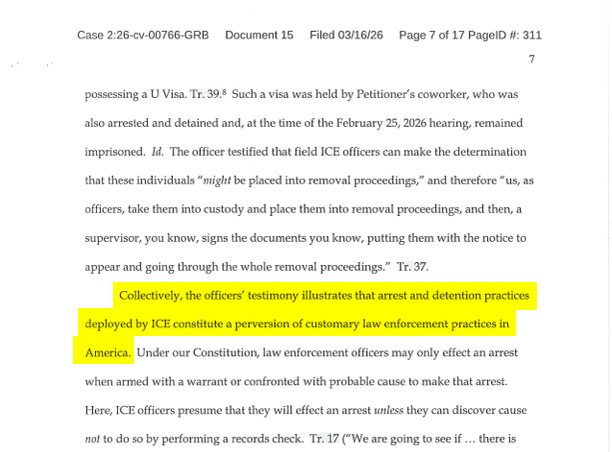
“Collectively, the officers’ testimony illustrates that arrest and detention practices deployed by ICE constitute a perversion of customary law enforcement practices in America,” U.S. District Judge Gary R. Brown wrote in an order on a Special Immigrant Juvenile Status case.
On Long Island, immigration arrests reached historic highs early this year, aided by Nassau County's partnership with ICE. Last week, state lawmakers approved a measure that would ban the agreement between localities and ICE. Gov. Kathy Hochul signed the measure into law Thursday.
Rachel Davidson, who focuses on special juvenile status for the End SIJS Backlog Coalition at the National Immigration Project advocacy group, said young people with this protection "don’t know how to navigate the world anymore.
"They came here seeking protection, they went through all these steps, they did everything right," she said. "They thought the government was committing to protecting them, and what they’re seeing is the opposite of that."
Once a path to green card
Congress created Special Immigrant Juvenile Status in 1990. Immigrants and advocates view it as one of the more stable pathways to a green card.
A state family or juvenile court first must find a person under 21 was abused, neglected or abandoned by at least one parent and it isn’t in their best interest to return to their home country. With that, they can apply to U.S. Citizenship and Immigration Services for the special status.
Previously, approval provided access to deferred action from deportation and a legal work permit.
Last year the Trump administration attempted to end automatic consideration of deferred action and work permits for people with special juvenile status, but a federal judge in the Eastern District of New York blocked the effort, saying officials didn't take the proper steps.
But last month, the administration attempted to fix the procedural error and, starting May 10, people newly granted this status no longer have deferred action from deportation or work permits while they await a visa.
Special Immigrant Juvenile Status also opens green card eligibility — as long as an immigrant visa is available. But annual visa caps have created a backlog, especially for natives of certain Central American countries. Some of those young people wait five years for a visa to apply for a green card. Roughly 10,000 visas are available annually for "special immigrants," which the young people with this status fall into, according to immigration lawyers.
Theo Liebmann, a Hofstra Law professor and Youth Advocacy Clinic director, said the status is a path to gaining legal residency, but doesn’t grant that itself.
"So they’re in this kind of limbo," he said of the young people who have the status.
Applicants on the rise
Legislative changes to Special Immigrant Juvenile Status have expanded eligibility over the years. Roughly 78,000 people under the age of 21 applied nationally during the last fiscal year, up 10,000 from the year prior, and more than 66,000 since 2015, federal immigration data shows. The vast majority of applications are approved.
ICE detained 265 people nationally with Special Immigrant Juvenile Status between Jan. 20 and Dec. 20, 2025, according to a Department of Homeland Security letter shared with Newsday by the office of Sen. Catherine Cortez Masto (D-Nev.). The agency said that 132 young people with the status were deported last year, according to the letter from then-Secretary Kristi Noem, first reported by NBC News.
The Trump administration’s "continued efforts to target SIJS youth are unconscionable," Cortez Masto said in a statement, urging passage of a bill to eliminate the visa cap for young people with the status. The legislation was referred to the judiciary committee.
Aides to Sen. Kirsten Gillibrand (D-N.Y.) said they didn’t have information on more recent special juvenile status detention numbers, or how many New York recipients have been impacted.
Sen. Catherine Cortez Masto (D-Nev.), shown with Sen. Chuck Schumer (D-N.Y.), is seeking to pass a bill that would eliminate the visa cap for young people with Special Immigrant Juvenile Status. Credit: AP/Mariam Zuhaib
In a statement to Newsday, James Martin, a spokesman for Senate Minority Leader Chuck Schumer (D-N.Y.), called ICE's actions "unjustified and wrong.
“They came to the United States for safety, followed a legal process, and are now living in fear every day," Martin said, calling for ICE reforms "with clear guardrails [and] real oversight.”
Both ICE and U.S. Citizenship and Immigration Services referred questions about how many people it has detained with this status to the other agency. In an emailed statement, a Citizenship and Immigration Services spokesperson said the program has been exploited "by criminal aliens, including gang members, seeking to infiltrate our country."
"We are restoring the SIJ program to its original purpose — protecting abused, neglected, or abandoned children as Congress intended," spokesperson Zach Kahler said.
A July 2025 report issued by the agency found that more than half of petitioners applying for the status during the 2024 fiscal year were over 18 and were raised by at least one parent. It said more than 500 known or suspected members of MS-13 have been approved for the status since 2013 — roughly 0.16% of the 300,000 applicants — and that age and identity fraud are a "persistent trend" in the program. Since 2013, more than 90% of people with this status are from Guatemala, El Salvador or Honduras.
Watch: 'The possibility of them getting a green card is too remote'

Jessica Vaughan, the director of policy studies at the Center for Immigration Studies, a Washington D.C.-based group that favors reduced immigration, said the Trump administration’s efforts to stop "rubber stamping" these applications is good policy.
"There has been very little integrity in the administration of the program and clearly inadequate vetting and inattention to the merits of these cases," Vaughan said.
But Jordan, the immigration attorney, said the program protects people who’d otherwise "have to go back to ... horrific violence, often neglect, just nobody to care for them."
"We, America, cared about that," she said. "We did care at one point, and I think we should still care."
Living in fear
Marina Ostrovskaya, who manages the Special Immigrant Juvenile department at Hempstead-based Jadeja-Cimone Law, said family court judges last year approved 555 of her office’s cases, the first step to applying for this federal status.
"The stories that we are seeing are one or both parents failing to provide financial support for the minors, even when they are living with them. We often have minors that cannot attend school after the age of maybe 12 because it’s too expensive and because the secondary school would be too far away and they don’t have a means of transportation to get to that school" Ostrovskaya said.
Last May, a Suffolk County Community College student was detained by ICE in her family’s Mastic apartment while immigration authorities looked for someone else. Sara Lopez Garcia, who had Special Immigrant Juvenile Status and came to the United States when she was 15, voluntarily deported back to her native Colombia last summer after being in immigration detention in Louisiana.
The young neuroscience major from Uniondale attending college upstate says she lives in fear of a similar outcome.
She hadn't seen her mother for years before coming to the United States in 2019.
"I really needed my mom. Over there, I suffered a lot of bullying," she said of her native Honduras. "I couldn’t deal with it anymore."
"I was scared about everything, so I just made my choice to leave the country," she said.
I was scared about everything, so I just made my choice to leave [Honduras].
— 20-year-old Uniondale woman with Special Immigrant Juvenile Status
College felt out of reach, but with the help of her school counselor in Uniondale she applied, becoming the first person in her family to attend. She wants to be a nurse.
Her anxieties heightened this February when ICE agents arrested a Columbia student at her campus apartment. The Columbia student, who was also studying neuroscience, was later released.
"I thought the universities were a safe space to be. If they could do that, I was like there’s no way they won’t come and open these doors and take a person like me," said the Uniondale woman.
Arlette Herrera, a senior staff attorney at Safe Passage Project and the young woman’s lawyer, said she often tells clients it’s a long and time-consuming process. On top of the wait to get a visa to apply for a green card, it can take up to a year to get legal permanent residency.
After five years of waiting for a visa to become available, the 20-year-old was sitting in a dance studio at school with some friends when she received the call from Herrera in March: She was finally eligible to apply to become a legal permanent resident.
She said she started shaking.
Her next call was to her mom, who works in construction.
"She was so happy, too. I think it made our day, our week, the month and everything," the young woman said.
If she gets her green card, the 20-year-old said she’d like to return to Honduras to see her 62-year-old grandmother, who would keep her company while she did her homework in grade school, sometimes falling asleep on a chair or the couch as the hours dragged on.
After graduation, she’d like to visit her friends’ hometowns in Oregon and Texas to hike and see a rodeo.
For now, though, the young woman continues to worry about the immigration arrests happening on Long Island that she sees on Instagram, sometimes close to her house or a school that her friends attend.
"We came to this country because of safety," she said, "and right now we're not feeling that safe."
