

Sex trafficking on Long Island and hotels: Newsday found 59 places cited in trafficking and prostitution charges, some involving children

Babylon Town Investigator Eddie Salas pulled up next to a motel in an unmarked town-owned car. It was late afternoon, just after work — which investigators say is a prime time for customers looking to buy sex at hotels. He watched as a couple of men headed into rooms but decided it wasn’t clear that anything illicit was going on.
He turned to his phone and scanned the online sex ads featuring photos of nude or partially nude women. He wasn’t optimistic because the town has been coming down hard on illegal activities at area hotels and motels. But within eight seconds, he found an almost entirely nude blond woman advertising body rubs and sex acts in Lindenhurst. Using WhatsApp, he texted her: "Where are you?"
She responded immediately and told him her room number, 204, and motel, the Super 8 motel in Lindenhurst. It was about five minutes away.
"I’ll take care of you good, baby," she texted.
He asked about rates.
She texted back:
"10 minutes 80 roses.
"15 minutes 100 roses.
"1 hour 200 roses."
He texted that he was on his way. One minute after he pulled into the lot, she called him:
"Hey baby, you here?" she said.
"Yeah, I’m in the back," he replied.
"OK, my love, I’m in Room 204. Just knock on my door," she said.
"OK," he replied.
From small mom-and-pop operations to high-end national brands, Long Island’s hotels and motels are convenient hubs for sex traffickers and their clients. Hundreds of online ads placed daily on adult websites reveal rampant prostitution occurring across Nassau and Suffolk counties. Despite high-profile law enforcement takedowns of trafficking operations and local government efforts to add tougher laws and better enforce codes, the illegal business is thriving.
Newsday compiled a first-ever database documenting sex trafficking and prostitution charges at hotels and motels across Long Island, offering more details than even local law enforcement officials have been able to piece together. A map produced by the Suffolk County Sheriff’s Office pinpointed 32 hotels and motels in Nassau and Suffolk identified through interviews with trafficking victims at the jail. After reviewing police and court records, the Newsday investigation uncovered nearly 60 hotels or motels across the Island where these paid sexual encounters occurred in recent years, one involving a victim as young as 11.
Records could not be obtained in time for publication for every hotel or motel where trafficking and prostitution have been alleged. Of the 59 hotel cases reviewed by Newsday, about 17% involved minors. Six of the hotels have closed. Three were deemed public nuisances, one was closed after a fire and one was closed after its owners were charged with trafficking. The reason for closing the sixth is not known.
"It happens at every hotel," said Christine Guida, deputy bureau chief of the Nassau district attorney’s Special Victims Bureau. "It happens at the high-end hotels where you’re blocking off rooms for weddings and you’re putting your family up for holidays when they come to visit you. It’s happening at the hourly motor lodges and hotels. But it is happening everywhere."
A majority of victims are trafficked at hotels and motels, according to the most recent national data available on human trafficking. A 2022 study by researchers at George Mason University in Fairfax, Virginia, found 79% of victims calling the National Human Trafficking Hotline had been exploited at hotels and motels. A 2023 study of federal prosecution data produced by the Human Trafficking Institute, a nonprofit based in Dallas, found hotels and motels were the most common location for commercial sex.

The Long Island Marriott in Uniondale, where prosecutors said a Queens man, Jorge Ramos, trafficked a woman by blackmailing her with a compromising video. Credit: Newsday/Steve Pfost
Some are hotels that rent rooms by the hour, like the Bay Shore Inn. There, records show accused trafficker Danny St. Louis shared drugs and had sex with a 13-year-old girl who later went missing for 25 days and was found on a yacht in Islip. His co-defendant, Samantha Wimmer, was charged with attempted sex trafficking and promoting prostitution. Others are larger corporate hotels, such as the Long Island Marriott in Uniondale, where a Queens man, Jorge Ramos, trafficked a woman by blackmailing her with a compromising video, according to a Nassau district attorney’s news release about his Oct. 27 guilty plea.
Hector Patel, manager of the Bay Shore Inn, denied any problems. "No sex trafficking ever came here," he said, adding, "We never take underage girls."
Naveen Shah, whose company, Royal Blue Hospitality, operates the Long Island Marriott, did not respond to a request for an interview about trafficking at the hotel.
Online sex ads
Babylon Town Investigator Eddie Salas uses online sex sites to set up paid encounters with women at hotels. Credit: Newsday/Steve Pfost, bottom photo by Randee Daddona
Just as hotels are critical to the trafficker’s business model, so are online sex ads. Salas was able to set up an encounter for paid sex with a woman at a motel in about the same amount of time it takes to order a pizza. A Newsday review of just one online sex site showed just how easy it is.
Over a 2½-hour stretch one Wednesday morning in November, 99 ads were placed on Megapersonals advertising prostitution services in a staggering 46 Long Island communities. Many of those ads were of women willing to meet men in multiple hamlets, with some specifically mentioning hotel or motel availability.
Nineteen of the communities were in Nassau County, 27 in Suffolk.
No community was featured more than Islandia, which was listed as a location in 35 advertisements during those 2½ hours. Four of those ads specifically listed the address for the Hampton Inn on Veterans Memorial Highway in Islandia. A hotel spokesman declined an interview, but issued a statement: "The hotel has protocols in place, aligned with guidance and resources provided by the American Hotel and Lodging Association and the brand, that all of our associates are trained in annually."
Westbury (13), Hauppauge (11), Farmingdale (11), Riverhead (9), Copiague (7) and Ronkonkoma (7) were the other communities listed most often that morning.
Each Long Island town west of Riverhead was reflected in the listings along with the cities of Glen Cove and Long Beach and a generic listing for "The Hamptons."
Senior Assistant Town Attorney Jorge Rosario at Babylon Town Hall in Lindenhurst. Rosario heads the quality of life unit. Credit: Newsday/Steve Pfost
At the Super 8 motel where Investigator Salas set up the appointment, he and his boss, Senior Assistant Town Attorney Jorge Rosario, discussed whether to confront the manager then. They decided instead to take down the license plates of every car in the lot to build the case and to return later to serve them with summonses for operating without a certificate of occupancy for a massage establishment and for allowing prostitution, which is prohibited conduct.
Salas texted the woman: "My wife saw my location. I’ll be back tomorrow."
Salas and Rosario are part of a unit set up three years ago to deal with residents’ complaints about everything from noise to garbage at residences and hotels. The unit has grown to 10 people. Increasingly, they’ve found themselves having to address the problem of sex trafficking at area hotels, and they work with the Suffolk County Police Department on those cases. Because traffickers typically deal in drugs or guns, as well as women and children, their illegal activity often leads to more crimes.
Under New York law, prostitution is a misdemeanor. Patronizing a person for prostitution is also a misdemeanor. If the person being patronized is younger than 15, it is a felony. Records examined by Newsday show other crimes, like robbery, assault and drug possession, frequently occur at hotels where there has been prostitution or sex trafficking.
"Once they get in, they kind of rule the roost," said Bradley Lopez, whose family owns the Bethpage Motel and who said he has taken steps in the last five years to prevent sex trafficking at his property. "Once you let them in the door, it tends to flourish."
That’s what authorities contend happened at the Sayville Motor Lodge, which police and federal agents raided in November 2022. The owner, Narendarakuma Dadarwala, 78, was complicit, giving pimps cheap hotel rooms in exchange for payments, Assistant U.S. Attorney Catherine Mirabile said during the trial of a Delaware man, Michael Johnson, who was convicted in October of sex trafficking and interstate prostitution at the motel.
Police and federal agents raided the Sayville Motor Lodge in November 2022 as part of an interstate sex trafficking investigation. Credit: Michael A. Rupolo Sr.
Dadarwala and his wife, Shardaben, 71, also warned traffickers when police were around. The trafficking was so open that they sold Trojan Magnum condoms for $1 at the front desk, according to testimony.
"Everyone profited, except the victims," Mirabile said.
Both Dadarwalas and their former manager, Ashokbhai Patel, 61, have pleaded guilty to sex trafficking conspiracy. The Dadarwalas’ son, Jigar, 47, and alleged trafficker Timothy Bullen, 38, also have been charged, but have not yet gone to trial.
The motel has closed. A buyer, identified only as a principal of a neighboring business, purchased it for $2 million in a court-ordered sale in October 2023. Proceeds of the sale were to be used to pay the lenders on the property and the rest were earmarked for government forfeiture, Newsday has reported.
Newsday contacted hotel owners and managers of the 59 establishments where prostitution or sex trafficking has been documented. More than two dozen responded. They either denied it happened at all or said they had taken steps to prevent it.
Rajen Patel, Long Island representative of the Asian American Hotel Owners Association, declined to comment.
"Nobody benefits from this kind of business," said Bharat Gandhi, owner of Abbey Motor Inn in Huntington Station, one of the motels where convicted sex trafficker Michael Howell rented rooms for himself and women he sold.
Gandhi said he installed cameras in August. "That really cut down the problem," he said, adding, "They go somewhere else."
Howell, who was accused of using violence and drugs to force women to prostitute themselves, also rented rooms at the Rodeway Inn in Huntington Station, the Super 8 in Lindenhurst and the South Bay Motel in Copiague, according to court records.
The evidence at his trial in August showed that he often booked rooms at one motel for several days before moving on to another one. He came to Long Island from Brooklyn because the motel rooms were cheaper, a Suffolk County detective testified.
"I think that room that day was like $104 and usually in Brooklyn, he said they were like $200 to $300," Det. Matthew Skulavic said.
Howell was sentenced in September to 13 to 29 years in state prison, Newsday has reported.
Traffickers can make a profit of up to $2,000 a day, said Anne Oh, former Suffolk sex crimes prosecutor who is now deputy counsel to the Suffolk Department of Social Services.
"The trafficker can rent a block of hotel rooms. During that time, he’s usually selling drugs at the same time. And then he’s using $25 a day for heroin or crack, keeping the girls high the whole day, 10 dates, it’s about a thousand dollars, $2,000 a day for $25 and cost of the hotel room for the day," she said.
The owners of both the Rodeway Inn and South Bay Motel denied they had a sex trafficking problem. Pallavi Gandhi, whose husband manages the Super 8 motel in Lindenhurst, said there was no prostitution at the Super 8 and that she wasn’t concerned about it. Manager Dipak Gandhi said in a later phone interview that he has kicked out "four or five people."
Children being trafficked
Increasingly, authorities say they have been alarmed by the number of children they are seeing being trafficked.
In August 2024, the FBI received a tip from the National Center for Missing and Exploited Children: An 11-year-old girl from Ohio was being trafficked on Long Island. The FBI narrowed down her location to Babylon and contacted Det. Sgt. James Johnson at Suffolk’s First Precinct, which polices that area.
Johnson, who works with a trafficking task force, told the Babylon Town Board in December 2024 that detectives checked sex websites and found a sexually explicit ad for a child being sold out of the Red Roof Inn in Copiague. In all, they found 34 sexually explicit ads listing the Red Roof’s address.

The Red Roof Inn Copiague, where federal agents and local police in 2024 found an 11-year-old Ohio girl being sex trafficked. Credit: Newsday/Steve Pfost
Detectives and town investigators immediately went to the motel. They found the child there with a 35-year-old woman, according to police and court records. They had two rooms — one was where her trafficker stayed and handled the money and the other was where sex acts took place. Both were littered with boxes of condoms, cellphones, cash and lingerie, Johnson said.
The girl was reunited with her family, and authorities opened an investigation, he said. A spokesperson for the U.S. attorney's office declined to comment.
The Suffolk district attorney charged the 35-year-old woman with prostitution and promoting prostitution, according to police records. After pleading guilty to disorderly conduct, she was sentenced to a 1-year conditional discharge. She was found to be a victim herself, and authorities cannot discuss her case, Suffolk district attorney spokeswoman Tania Lopez said in an email. The woman, whom Newsday is not naming because she is a victim, did not respond to calls or texts for comment.
Red Roof owner Shiv Patel appeared at the town board meeting. He said he agreed to hire security, require IDs at check-in, install better cameras and post signs listing prohibited behavior. The motel also trained employees and instructed housekeepers to alert the front desk if they find any drugs in rooms so that the guest can be checked out.
"I don’t want to have this issue," Patel said.
He did not respond to multiple requests for an interview.
Trafficking case at Ronkonkoma hotel

Convicted sex trafficker Johnathan Wright tortured two young women at the Clarion Hotel in Ronkonkoma. Credit: Newsday/Steve Pfost
Trafficking investigators say the cases they see at hotels are often horrific.
In 2024, Oh prosecuted a case against a trafficker, Johnathan Wright, who tortured two young women with a hot iron. A crucial piece of evidence in the case was photos of one victim’s burns, which exactly matched the model of irons used at the Clarion Hotel in Ronkonkoma, where the women were staying.
"You could actually see the shape of the iron, the steam vents where the steam comes out of, the full iron, all throughout her body," she said.
Wright had told the women to massage him and to continue after he fell asleep. They were so exhausted that they fell asleep, which enraged him when he woke up. To punish the women, he punched them, threatened to throw one victim out the window and choked both with a belt around their necks. He warned them that if they screamed, the abuse would only get worse. After he burned their naked bodies, he made them stand in a hot shower, according to court testimony.
In Wright’s case, only one victim, who is developmentally disabled, was willing to testify.
"A lot of times when we’re dealing with these trafficking victims, they say, ‘It’s my choice to sell my body,’" Oh said. "And we say, "Yes, maybe, but you didn’t have your ID, you weren’t allowed out of your hotel room, you weren’t allowed to contact your family, and you had no money, and food was given to you three times a day. So where were you free to leave?"
She added, "I think that when you have completely lost the sanctity of your body, if your body is the commodity you use to earn money, or earn good behavior toward you, all that’s left is your pride. So that admission of being a trafficking victim ... it’s a really difficult pill to swallow."
A jury convicted Wright of assault and witness tampering, and he was sentenced to 32½ years to 40 years in state prison.
Clarion’s owner, Hitesh Patel, denied that there had been any problems at his hotel when contacted by Newsday in October. "We don’t have anything like that," he said, before hanging up.
‘Liked pretty girls hanging out’
Kathy, who asked that only her middle name be used, was 14 when she met the man she said pushed her into prostitution, convicted sex trafficker Lorenzo Randall.
She was on the street with no place to go. She didn’t want to return to the group home where she had been living because she feared they would send her upstate to a locked facility. She didn’t think she could return home because she was angry at her mother for sending her to a group home in the first place, she said.
"These young women are vulnerable and they’re alone and they get induced into this," said former Suffolk Police Commissioner Geraldine Hart, who is now associate vice president at Hofstra University, where she oversees public safety.
The teen called a friend who told her about a guy who "liked pretty girls hanging out at his house."
She went to the house. The man was big, old and fat, around 60, she said. He had cards, dominoes and a bottle of Patron tequila. He started to touch her. She knew what he wanted but was hesitant.
"I don’t really know," she said. "Can you give me some time? I’ve never done this."
He got up and walked over to his phone to make a call. "Nephew," he said, "I got something that I think you would like to see," she recalled.
A much younger man came over. He was stylishly dressed. He introduced himself to her and asked her name. He said she was beautiful and sweet and immediately offered to help her.
She said she was impressed.
That’s the "Romeo" approach, said Sgt. Erin Meunkle, who runs a Suffolk County jail program that screens inmates for trafficking.
They left together. Before he walked out, he gave the man who called him $200.
That also was not unusual, advocates say. Traffickers, many of whom are affiliated with street gangs on Long Island, have associates feeding them information.
"They have a network," Oh said.

Former sex crimes prosecutor Anne Oh talks about a case she prosecuted against a sex trafficker who burned two women with a hot iron while they were staying in a hotel. Credit: Newsday/Kendall Rodriguez
The teen got into his BMW and they drove around for a couple of hours talking. He asked about her life and shared some details of his. He seemed vulnerable. He told her he wanted to marry her and make babies with her. He even sang to her, she said.
Finding out details of the teen’s life is important to traffickers in order to manipulate them, according to a convicted sex trafficker interviewed on video by Bill O’Leary, a forensic psychologist based in Bohemia who works with traffickers and their victims.
"They’re being very predatory while pretending to be helpful," said Chitra Raghavan, professor of psychology and director of the forensic mental health counseling program at John Jay College of Criminal Justice.
The teen fell for it. She thought she had found someone who would take care of her, she said.
Then he showed her his money, clothes and jewelry. That, the trafficker said in the video interview with O’Leary, is also deliberate. It’s easy to solicit someone "when you have it all — full frontal flash," and they have nothing.
It worked. She thought, "Maybe my life is about to begin."
At the end of the night, Randall took her to a strip club for a drink. He said he was trying to make it in life and that she could be part of his team and make money. "You’re going to be great," he told her.
She was 14. She still had braces.
He said he had a bench of girls, but she was special. The other girls required his attention, but she was his favorite. He told her she was the most beautiful and would make the most money.
That pitch is part of the process of grooming, Hart said.
"Nobody starts by saying they’re going to get involved in this lifestyle. They’re groomed. And they are meeting people that are complimenting them and telling them what they want to hear," she said.
"Things took a turn really quick," Kathy said.
The next day, she was turning tricks in a Copiague apartment building. He would sit in the parking lot and watch men go in and out. She saw eight men in less than 12 hours. She charged $200 for half an hour and $400 an hour. She watched him count thousands of dollars at the end of the night, but she got none of it. He told her they were saving for a house in California, she said.
They stopped only after "the place got hot" and the police came, she said.
They moved on to the Bay Shore Inn, she said. They were there for weeks. Other hotels she said she worked in were the Days Inn in Bay Shore, the 112 Motel in Medford, the Radisson Hotel on Motor Parkway in Hauppauge, Holiday Inn Express in Hauppauge. Her trafficker would put five girls in five rooms, she said.

The Bay Shore Inn in Bay Shore, where one young sex trafficking victim said she worked out of for weeks. Credit: Newsday/Steve Pfost
"There’s a reason traffickers and their women are so mobile," said Yvette Aguiar, a retired NYPD detective trained in sex crimes and former Riverhead supervisor. "It’s so that the women don’t get familiar with their surroundings or anyone around them who could help them get out. It also helps them evade law enforcement. The constant movement is well thought out and part of the plan."
David Gandhi, who said he took over the 112 Motel five years ago, said he limits the number of guests and requires ID to prevent problems. "You just have to be on top of your game," he said.
The Days Inn in Bay Shore has been sold. The Radisson Hotel did not respond to calls or a visit from a Newsday reporter. The Holiday Inn Express also did not respond to a request for comment.
The teen said she didn’t do drugs because they made her sick, but occasionally her pimp forced the drugs on her. He started "gorilla pimping" her. That is when a pimp uses physical or psychological abuse to control his victim. If she talked back, he’d hit her or put out a cigarette on her arm or thigh. She had burns all over her body, she said.
It finally stopped when she was 21 and gave birth to a baby girl, fathered by a friend of hers. She couldn’t imagine that life for her daughter.
"That’s when everything changed for me," she said.
She went to nursing school and started a business. On her own, she still had sex with men for money around the holidays. She got arrested. A federal agent asked her if she needed help, the first time anyone had asked her that, she said.
She got counseling through ECLI-VIBES, an Islandia nonprofit that works with trafficking and domestic violence victims. Now 31, she said she hopes telling her story can help others.
"I need to make sure my pain has a purpose," she said.
Federal law allows victims to sue
The Trafficking Victims Protection Act, a federal law that enables prosecution of traffickers, was amended in 2008 to allow victims to sue people and companies who knew or should have known they were making money from trafficking, said Steve Babin, an Ohio-based attorney who sues hotels and motels on behalf of victims.
Babin said he filed the first such suit in 2019 and now has clients in every state. Of the thousands of suits he has filed, the top defendants are Wyndham, Best Western, Red Roof and Choice hotels.
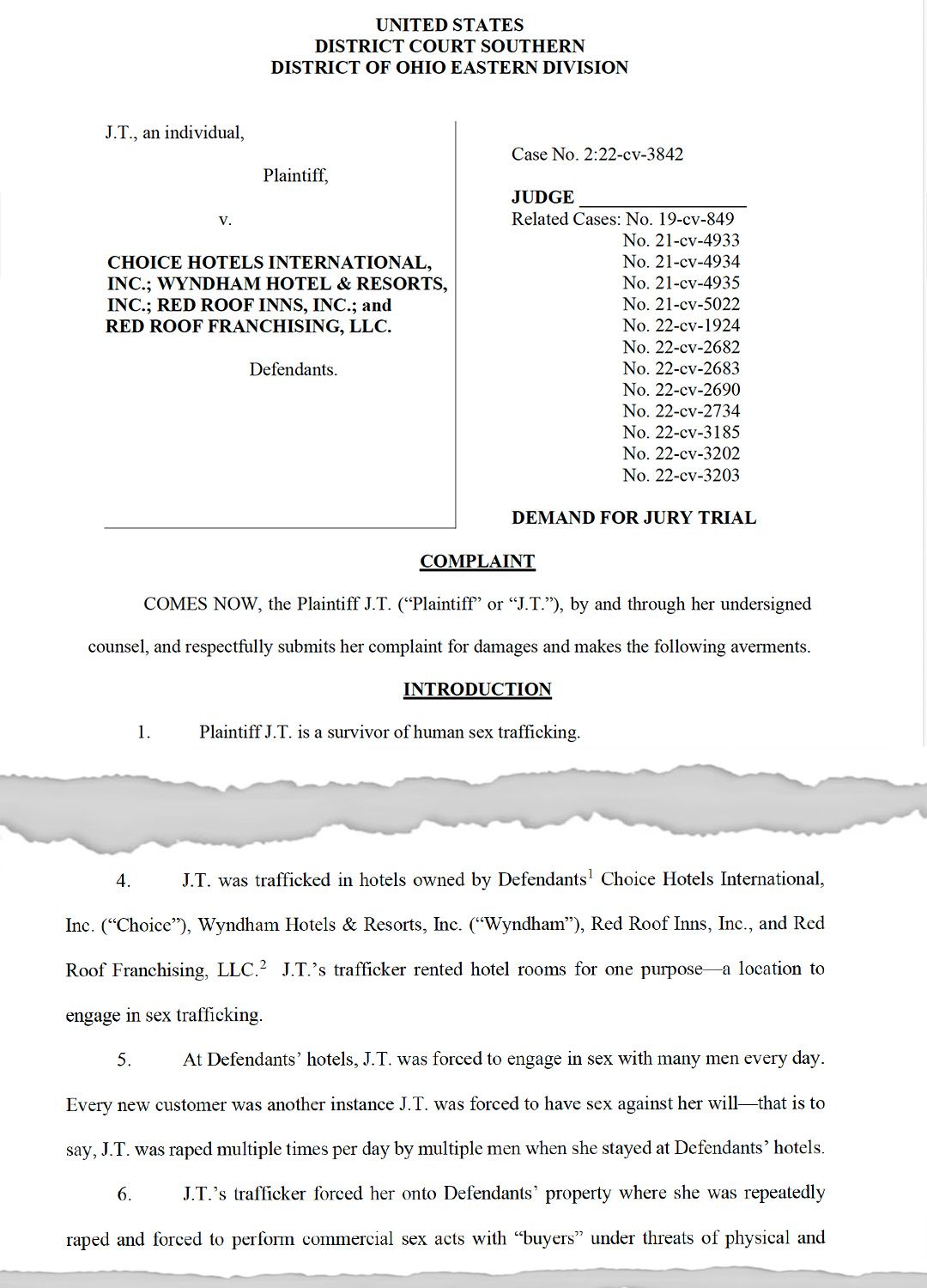
Wyndham, Red Roof and Choice hotels are named in a lawsuit in which a victim seeking damages alleges she was kidnapped and trafficked out of hotel rooms when she was 16.
All these franchises have locations on Long Island.
Randy Janis, a Manhattan-based attorney who files suits under the law, said traffickers frequently use budget hotels, the kind where an average person would stay during a road trip.
Customers "don’t want to go to a trap house [a place where illegal drugs are sold] or buy sex on the street. They want to go somewhere relatively safe ... but that’s anonymous, as well," Babin said.
Janis and Babin have filed suits against the Red Roof Inn in Westbury, and both suits are pending. They allege the proprietors knew or should have known that women were being trafficked.
The suit filed by Babin says the victim, identified only by her initials, was beaten by her trafficker and that her "screams for help could be heard from the room." There were other red flags: paying in cash, paying for extended stays day to day, physical abuse in public spaces and a large number of men coming in and out of her room.
The Janis suit alleges there were obvious warnings. The victim had visible bruising, was malnourished, wore sexually explicit clothing, was sleep deprived and often impaired by drugs or alcohol. The suit also alleges the trafficker paid off Red Roof staff to warn him of police activity.
Red Roof’s attorney, Richard J. Femia, of Garden City, filed a response denying the allegations and stood by that response when Newsday called for comment about the case.
The Pines Motor Lodge in Westbury is the defendant in a similar lawsuit. In that case, filed in February, the plaintiff, identified only as K.R.W., said she was trafficked from January through March 2015 at the motel. The suit alleges sex trafficking was ongoing at the motel and that staff did not take reasonable steps to report it.

A woman alleges in a lawsuit against The Pines Motor Lodge in Westbury that she was trafficked there for three months in 2015. Credit: Newsday/Steve Pfost
K.R.W. said her rooms were paid for with cash or prepaid cards, that she never showed an ID, that she and her trafficker would stay for multiple days at a time, that she frequently requested fresh towels and linens day and night, that drugs and sex paraphernalia were found in rooms she used and that there was heavy foot traffic in and out of her room.
In addition, she alleged hotel staff and management would solicit sexual services from her.
Debra Sammartino, whose company owns the motel, did not return a call for comment. Her attorney, Patrick Argento, declined to comment, but filed a reply to the complaint denying the allegations.
Janis said his law firm took on the trafficking lawsuits "as a way to level the playing field.
"We’re dealing with the type of people where nobody’s lobbying for them, sometimes not even their families," he said. "They don’t have anybody else looking out for them."
What matters to the victims, Babin said, is "that they help other women in same situation."
‘Turning a blind eye’
Both Janis and Babin said they believe the hotel industry has been aware of the sex trafficking problem for some time. Babin said the industry has been reluctant to act because trafficking can be a public relations problem and they also don’t want to lose revenue.
"Whether they’re actively turning a blind eye to stuff that they know is trafficking or whether they’re just not properly trained, the result is that’s where it happens. And it’s the market," Babin said.
Dorothy Roberts, president of the Long Island Hospitality Association, a trade association, said she "categorically" disagrees with that.
She said while human trafficking goes on everywhere, she doesn’t see it as a "huge issue" on Long Island. Nonetheless, "It’s definitely a topic that is brought up in the hospitality industry. Hotels want to provide a safe environment and a safe stay."
She said branded hotels, such as Hilton and Marriott, post signs with a phone number for human trafficking victims to call. They also give new employees training on signs of human trafficking.
To combat trafficking, legislation has been proposed in Suffolk County that would enforce a six-hour minimum at hotels and motels. It also would require them to keep photo IDs for five years and security footage for 90 days, Newsday has reported.
Nearly all the hotel owners and operators who responded to Newsday’s queries said there are ways to cut down the problem, from limiting the number of guests in a room to alerting law enforcement when there are signs of illegal activity.
"It’s definitely something that I don’t want to see in my hotel, and I don’t want to see in any hotel," said Nicholas Bridges, manager of La Quinta Inn and Suites Bohemia, where some victims have told authorities they were trafficked.
His staff requires guests to provide ID and a matching debit or credit card. Additionally, housekeeping staff are trained to alert managers of any suspicious activity, such as drugs or multiple condoms in a room. Whenever he gets such information, he calls the Suffolk County Crime Stoppers hotline, 800-220-8477, as well as Suffolk detectives, he said.
If there are frequent visitors, we shut it down. ... We’d rather lose that business upfront than have that kind of headache.
—Asad Rana, manager of the Swiss Motel in Riverhead
Asad Rana, manager of the Swiss Motel in Riverhead, said his employees now ask about the number of people staying in a room and whether there will be visitors.
"If there are frequent visitors, we shut it down. We don’t take that anymore," he said.
He said that change has helped. "We’d rather lose that business upfront than have that kind of headache."
Other steps identified by ECPAT-USA, an anti-trafficking nonprofit, include not permitting cash payments, requiring vehicle registration and photo ID at check-in, monitoring online sex ads for their hotel name and photos of rooms, changing Wi-Fi passwords regularly, watching the number of visitors to a room and developing a protocol to respond to signs of trafficking.
Former ambassador to Greece George Tsunis, who owns the Hampton Inn in Commack, said with the increase of online bookings and key fobs sent to a phone, it can be difficult to prevent trafficking at a hotel, "but it’s very, very easy to stop once you realize it’s going on."
He has installed a sophisticated camera system and employees know to call authorities. "This is a moral absolute," he said. "If it comes to our attention that there’s a trafficking situation, we’re calling 911 instantly."
What investigator sees is 'heartbreaking'
For Babylon Investigator Salas, what he sees is often "heartbreaking."
A neighbor of the Sunview Motel in West Babylon said in an interview he complained to the town about the motel because women were banging on his door late at night crying for help. Before he could get to the door, they’d run away. The man, who asked not to be identified because of concerns about retaliation, said town officials responded immediately and surveilled the motel.
Town investigators saw multiple men going in and out of rooms and even found a woman operating a massage business out of one room. Officials met with the owners, Rujesh and Hermina Patel, who said they were unaware of any problem. During a follow-up visit, investigators found that same woman with her massage table and a man hiding in the room. She was ticketed for not having a certificate of occupancy for a massage business, according to testimony at an August 2023 town board hearing.
While getting a ticket for not having a certificate of occupancy might seem minor, things have been quiet at the motel since then, the neighbor said.
During a town board hearing, the Patels’ daughter, Sia, said, "We have tried to maintain the best environment for our neighbors." They did not respond to a call for comment from Newsday.
A nuisance complaint filed by the town can disrupt a business. Because such complaints are filed with the county clerk, they show up in title searches when a business is seeking a bank loan, Rosario said.
The town plans to keep up the pressure on offending hotels and to adjust their tactics as necessary. "You have to adapt to the criminal activity because they adapt," he said.
