Pandemic leaves LIRR train artist isolated

The daily 8:30 train from Rockville Centre used to present fresh models for artist Naomi Grossman to inconspicuously finger-sketch on her iPad.
Those people hunched over smartphones. Some lady with hair in a bun, clothing hung up above, focused on a pocket mirror and putting on makeup. That guy sprawled out with his feet on another seat.
“Very often, on the way home, you could just see the body language revealing the weight of the day,” said Grossman, 70, who sketched (mostly) unwitting commuters aboard the Long Island Rail Road, on and off over seven years and three iPads.
Now, in isolation due to the coronavirus pandemic, she makes portraits of herself and of her “model prisoner” as a muse: her husband, Floyd, reading in their two-story Colonial, watching TV, sleeping. Repeat.
Like artists around the world, Grossman — a high-school-math-teacher-turned-artist whose primary work includes sculpture, mixed media and painting — is being confronted with a fundamental question: what to make in the face of a worldwide health crisis.
“Some people think the pandemic is a great time for artists to be creative. I’m just like you- anxious, unsettled, sad beyond belief, talking to people a lot, worried about everyone , scared for our democracy,” she posted last week on Instagram. “It’s hard to concentrate. It’s hard to be creative and get into a zone.”

Naomi Grossman, an artist who lives in Rockville Centre, has inconspicuously sketched hundreds of strangers aboard the Long Island Rail Road, such as this woman. Credit: Naomi Grossman
Even before the pandemic, Grossman’s work had meditated on anguish and loneliness, including the chicken-wire sculptures “i despair,” a self-portrait, and “Assisted Living,” modeled on two life-size chairs and a foot stool and inspired by an old man bereft of human touch.
Grossman’s LIRR sketches began as a way to pass time during her commute to Long Island City, where her studio had been for 18 years before moving earlier this year to Glen Cove. Dragging her fingers on the tablet screen in the apps Brushes and Procreate — “adding and subtracting and adding and subtracting and adding and subtracting” — she had about 15 minutes maximum to draw aboard the trains themselves, and as few as three minutes to finish on the platform when she changed at Jamaica onward to or from Hunterspoint.
“I’m just working rapid fire, trying to catch the gesture, and when people were standing in the doorways, I was always fearful that they were going to be leaving any minute,” said Grossman, who grew up in Far Rockaway, Queens. She’s lived in Brooklyn’s Midwood neighborhood and Uniondale and has been in the same Rockville Centre house for more than 40 years with her husband.
On a round trip between Rockville Centre and Hunterspoint, she’d usually complete four sketches. And occasionally, a passenger would notice her staring or even the drawing itself, despite her efforts to be subtle.
“There were some people who were just uncomfortable and would step back so that I couldn’t see them anymore,” Grossman said. “Of course there were other people who would see me drawing and were fascinated and looking over my shoulder.”

One of the Long Island Rail Road passengers sketched between Rockville Centre and Hunterspoint by artist Naomi Grossman. Credit: Naomi Grossman
Pandemics have long influenced the subjects, styles and practices of art, profoundly shaping future generations of artists even once the health emergency is dormant, according to Suzanne Fraser, coordinator of the Centre of Visual Art at the University of Melbourne.
She said that from the experience of Black Death, which wiped out as much as 60% of the world’s population, emerged in the 1300s the ghoulish Danse Macabre, an allegorical image that appeared again and again through the Renaissance. Tuberculosis, which by the 1800s had killed 1 in 7 people who ever lived, gave rise to melancholy and bedside scenes, such as Edvard Munch’s “The Sick Child” series (1885-1926) and “Camille Monet on Her Deathbed” (1879) by Claude Monet. Artistic expression in the time of AIDS, which has killed about 32 million people, led to the use of activism, posters, billboards and quilting.

The Spanish flu has largely been absent from the artistic imagination, with a few notable exceptions, including this "Self-Portrait after the Spanish Flu" (1919) by Edvard Munch. Credit: Edvard Munch/Ove Kvavik
Largely absent from the artistic imagination is the Spanish flu, despite killing at least 50 million people circa 1918, according to Trevor Smith, who curated an exhibition at Philadelphia’s Mütter Museum on the pandemic. The exhibition has been closed because of the coronavirus pandemic.
So much attention at the time was focused on World War I and its political and social ramifications that the destruction of the pandemic was overshadowed, and “in a weird way, it did become almost invisible.”
“For an event that touched so many people,” Smith said, “there was so little lasting cultural trace.”
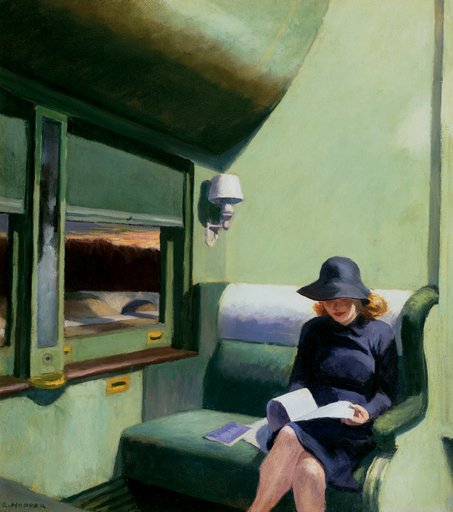
Art in which mass-transit strangers are the subject is almost as old as the mode of transportation itself, for both renown artists like Edward Hopper (“Night on the El Train,” 1918) and those undiscovered whose work never leaves their sketchbooks.
Grossman’s sketches were to be exhibited March 19 until July 5, among six artists’ work made aboard trains, subways and buses, at the Transit Museum’s Grand Central annex, but the museum was shuttered March 13 due to the pandemic. It’s unclear when and whether the exhibition will open, according to spokeswoman Chelsea Newburg.
But on May 5, Grossman presented her work in a digital discussion via Zoom, attended by about 80 people, Newburg said.
Grossman’s cousin, Judith Eisenberg, told a chat room during the discussion: “This makes me miss the community of commuting, especially during this time of isolation.”

Floyd Grossman, the artist's husband, sketched by his wife during the coronavirus pandemic lockdown at the couple's Rockville Centre house. Credit: Naomi Grossman
Exactly two months into the lockdown, Grossman has done at least 15 portraits of herself and 18 of Floyd.
“I love that my husband is wearing his mask here,” Grossman said, swiping to a black-and-white drawing of him reading in a small armchair. “It makes it so much easier to do a face.”

Matthew Chayes, a Newsday reporter since 2007, covers New York City.